Independent automotive research

See the evidence behind automotive product risk.

Reported field patterns. Company financial context. Evidence for your next decision.

EvidenceVantage is a decision support system (DSS) for automotive product risk. Its research reports help analysts and supply-chain professionals decide what deserves closer examination.

Decision support through research reportsCompany contextVehicle-level casesTraceable sources

01 / The problem

The blind spot:
the engineering signal behind the reports.

Individual complaint records provide fragments of an experience. Signs of a developing failure can emerge across related reports: symptoms that recur, persist, change, or disappear and return. For analysts and SCM professionals, that pattern can remain out of view until the reports are connected over time.

EvidenceVantage makes those reported patterns visible as trajectories, with a route back to the underlying records. The reader can examine how the pattern develops and decide what needs further investigation. Manufacturers’ reported warranty and related obligations add financial context to that view.

The economics of the recall world

Warranty obligations give the issue financial context. Complaint trajectories provide a separate view of reported field activity.

The financial footprint of vehicle warranty obligations

Reported obligations alongside cumulative complaint trajectories
Bars · Cumulative complaint trajectoriesLine · Reported closing obligations, USD bn
View chart totals
Totals for the selected reporting entities
PeriodCumulative trajectoriesClosing obligations · USD
Coverage, definitions and sources
Selected reporting entities, not an industry-wide total. Financial amounts cover worldwide issuer operations; complaint trajectories cover the mapped US complaint-source brands only. Trajectories accumulate from 1 January 2022, using consistent grouping throughout the period. Financial series retain issuer definitions, including differences in supplier-recovery treatment. Foreign currencies use the collected historical closing exchange rates. Volkswagen includes commercial obligations and is marked †; Porsche is not added separately. Annual periods are fiscal years ending in the labelled year; March and December year ends are distinct. The Q1 view uses a separate, fixed cohort with December annual closes and 31 March 2026 balances. Missing observations are not zero-filled.

A complaint trajectory follows a group of related complaint records over time. The line shows reported closing obligations, rather than a calculated total cost of recalls. Displaying the series together does not establish a causal relationship.

02 / Our approach

Make the record easier to examine.

Our analysis uses unsupervised learning to organize related complaint records. Selected cases are then examined against the underlying source evidence.

  1. 01

    Keep the source

    Retain complaint identifiers, dates and original narratives from the US National Highway Traffic Safety Administration (NHTSA).

  2. 02

    Follow the pattern

    Organize related records by vehicle and time. Show recurring themes, changes in activity and reported outcomes.

  3. 03

    Read in context

    Inspect the underlying accounts and distinguish what they describe from what remains uncertain.

  4. 04

    Support the review

    Present the relevant findings, company context and source references in a report tailored to the reader.

Evidence stays attached to the finding.

Company disclosures retain their reporting dates and scope. Vehicle cases retain their own records and observation periods. Complaints are reported experiences; each case makes the limits of the evidence visible.

03 / The professional view

Know where to look next.

Use the report to focus your review, prepare the next conversation and identify the evidence that deserves a closer look.

For credit & investment analysts

Arrive at the company review with specific questions.

Start with an organized view of reported field issues alongside the manufacturer’s financial context. Use it to guide your due diligence and the questions you raise with management.

  • Focus attention on patterns that warrant a closer look.
  • Prepare questions about warranty exposure, remedy progress and recurring reported issues.
  • Support a research note with dated, traceable source evidence.
Explore the analyst cases
For supply chain & field quality

Give the next operational review a clear starting point.

Bring a shared evidence base to discussions about cost of poor quality, remedy availability and repeat service. Help the team decide which reported experiences need further investigation.

  • Prioritize follow-up on recurring service and remedy issues.
  • Bring concrete field cases into discussions with quality, service and supplier teams.
  • Use component and geographic context to frame the next investigation.
Explore the SCM cases

04 / Case studies

Open the report.
Follow the evidence.

Two vehicle cases, each examined from an analyst and an SCM perspective. The reports show both a higher-volume case and a quieter one.

Report date: 28 September 2026Complaint evidence through 16 June 2026

The analyst perspective

First page of the Ford Escape · 2020 Analyst perspective report

Analyst perspective

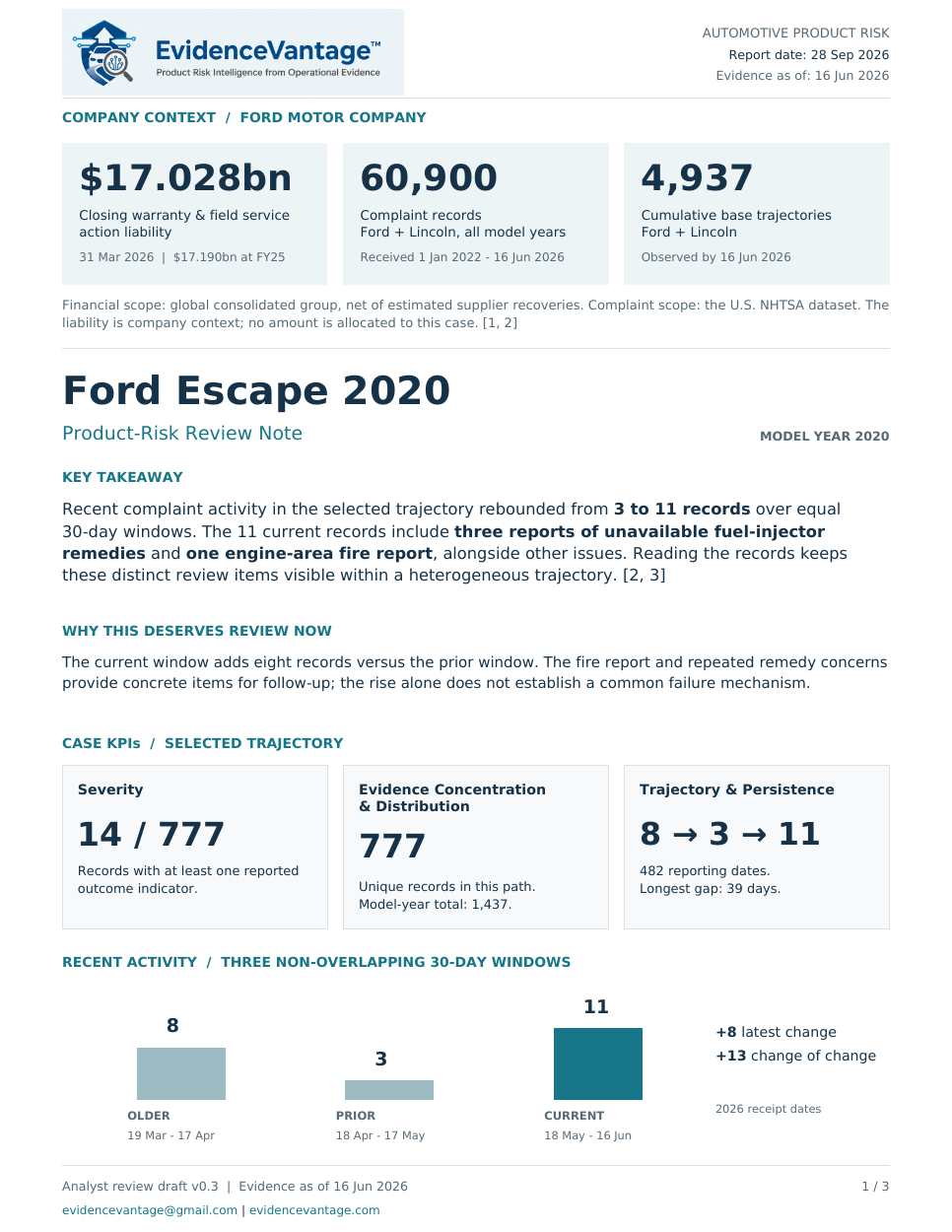
Ford Escape · 2020

Field patterns beside company disclosures

Company financial context, a selected complaint trajectory and source excerpts for closer review.

Read report PDF · 3 pages
First page of the Volkswagen Jetta · 2022 Analyst perspective report

Analyst perspective

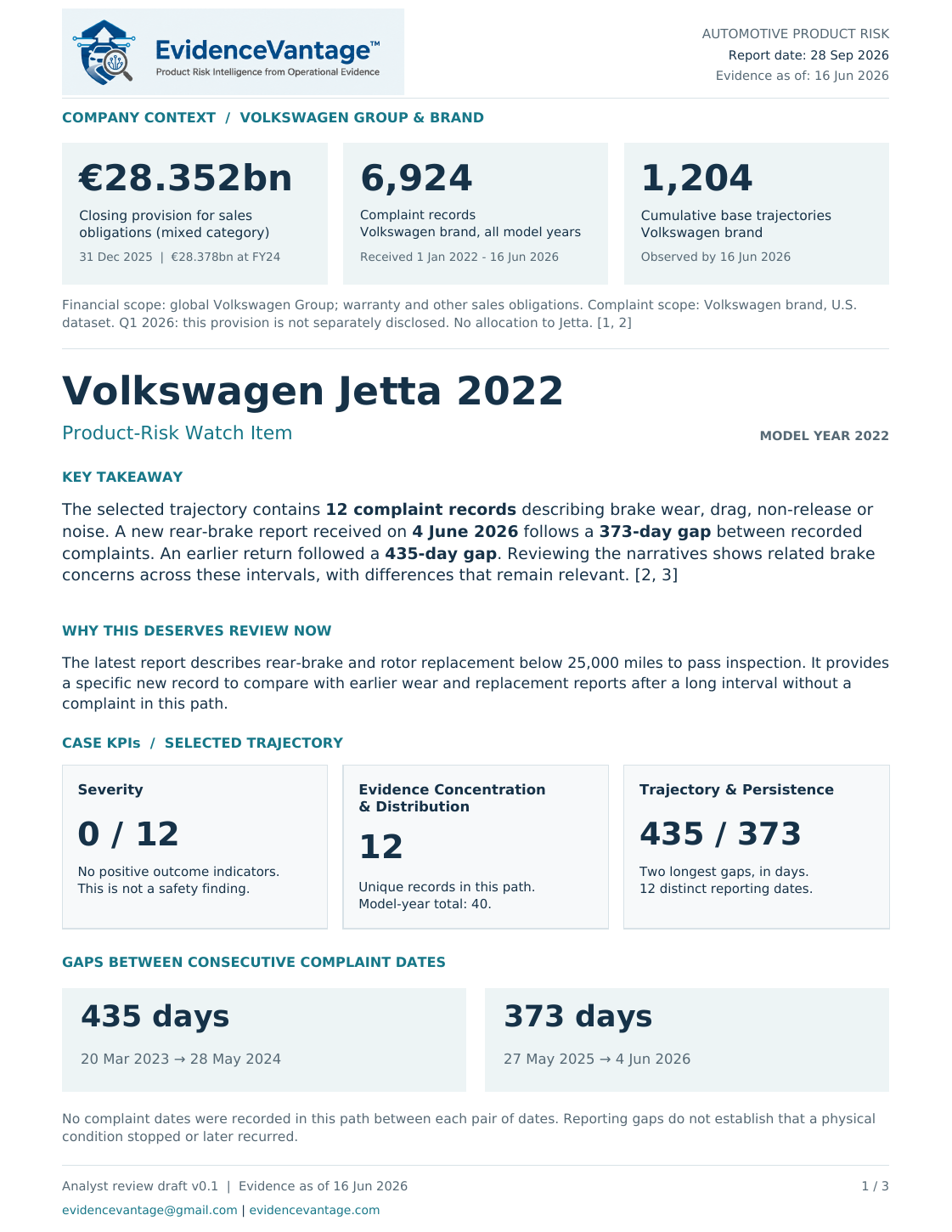
Volkswagen Jetta · 2022

A quieter case, examined record by record

A smaller set of complaints, its timing and reported outcomes, with the company disclosure kept in context.

Read report PDF · 3 pages

The SCM & field quality perspective

First page of the Ford Escape · 2020 SCM & field quality report

SCM & field quality

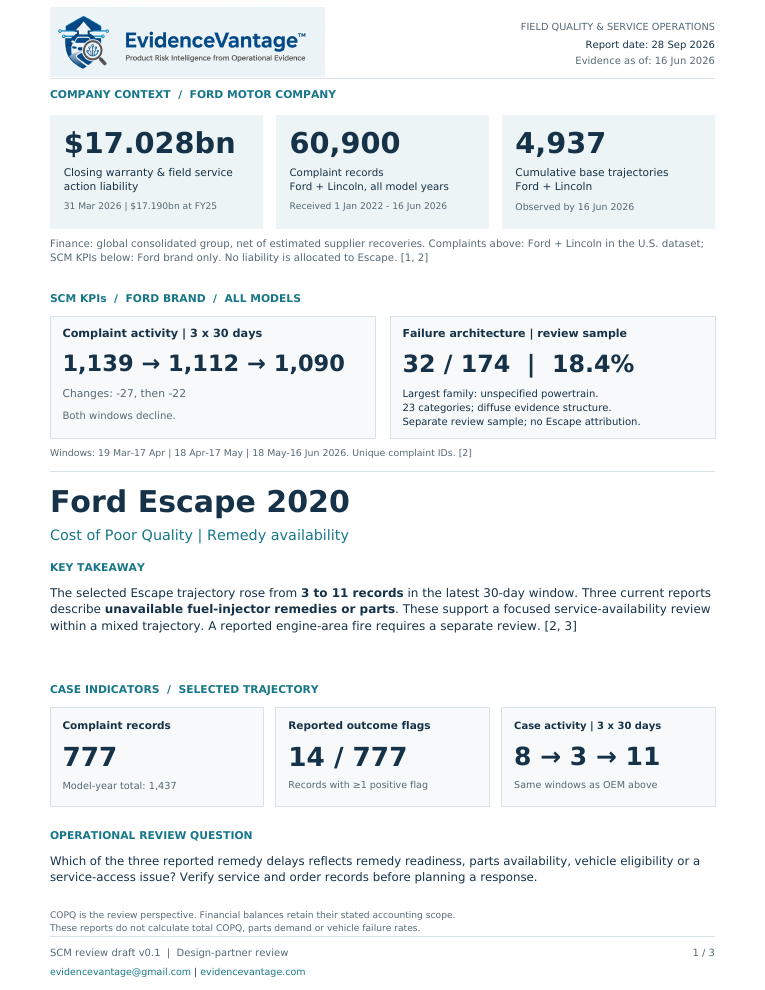
Ford Escape · 2020

Cost of poor quality: remedy availability

Reported repair and remedy experiences, component families and geographic context for operational review.

Read report PDF · 3 pages
First page of the Volkswagen Jetta · 2022 SCM & field quality report

SCM & field quality

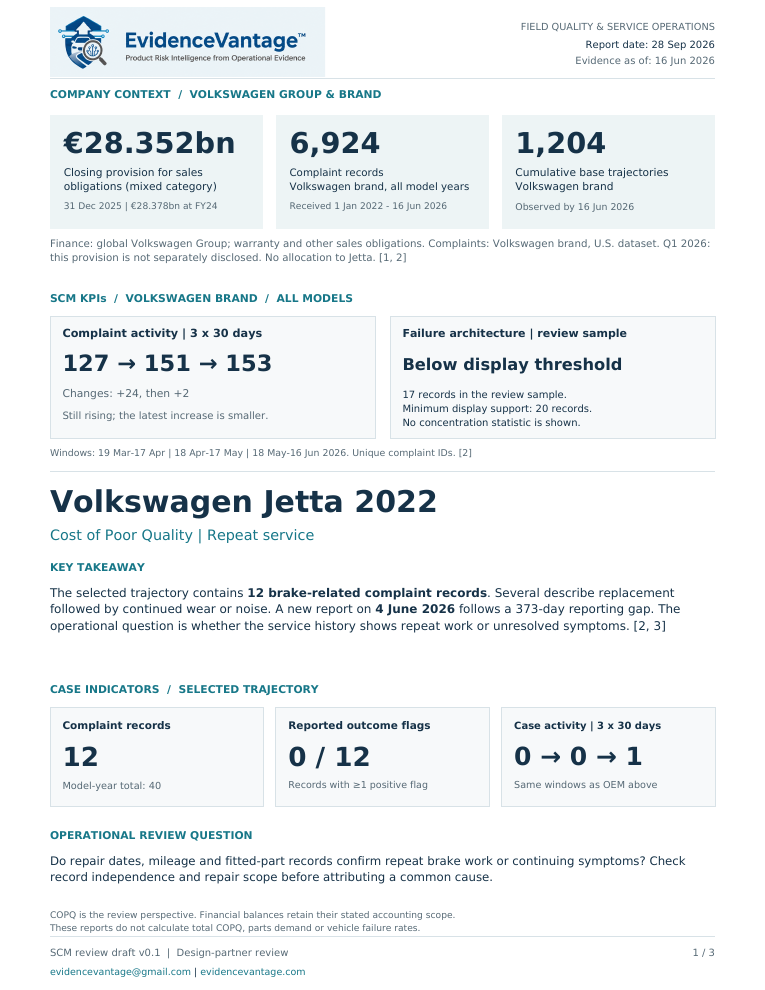
Volkswagen Jetta · 2022

Cost of poor quality: repeat service

Repeat service accounts in a lower-volume case, with a view of activity over time and reported locations.

Read report PDF · 3 pages

05 / Research notes

The questions
behind the work.

Selected research notes on quality management, reported field experiences and financial recognition.

Quality management · Research paper

When Toyota Says the Basics Must Change

An industrial-engineering perspective on measuring severity, persistence, recurrence and the spread of reported issues earlier in the quality process.

Read paper PDF · 3 pages

25 June 2026 · LinkedIn

The Alpha Gap

A research perspective on the gap between field evidence and its recognition in traditional financial analysis.

Continue the conversation

What would you want
to examine more closely?

We welcome conversations with analysts and supply-chain professionals reviewing automotive product risk.

EvidenceVantageAutomotive decision support